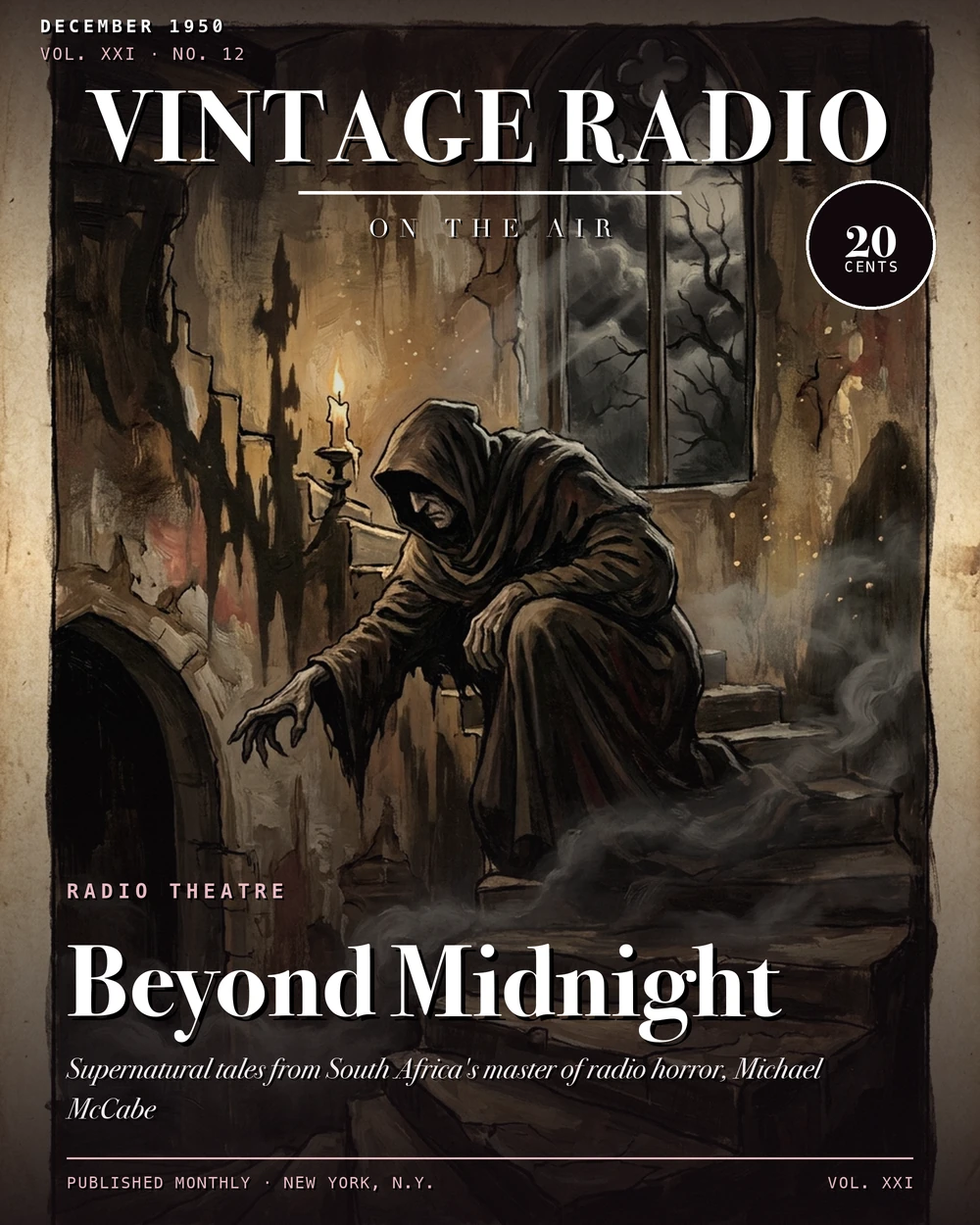
Beyond Midnight
One Man, One Show
What made Beyond Midnight unusual from the start was how completely it belonged to a single person. South African author Michael McCabe wrote it, produced it, and directed it — every episode, start to finish. That level of solo creative control is rare in any broadcast medium, and it gave the series a consistency of tone that anthology horror shows often lack. When you move through the run, you're hearing one sensibility at work, shaping each story from the page to the final mix.
McCabe didn't arrive at Beyond Midnight cold. He had already been producing a science-fiction anthology for Springbok Radio called SF'68, which adapted stories from writers including Ray Bradbury, Harlan Ellison, and Murray Leinster. Beyond Midnight replaced that series, and the shift in subject matter was deliberate — away from science fiction and toward supernatural horror. Themes of madness, murder, ghosts, and ghost hunters moved to the center. The success of Beyond Midnight outpaced SF'68 by some margin, and it's reasonable to credit the earlier series for sharpening McCabe's craft before he turned to the material he handled best.
What the Show Was
Beyond Midnight aired on Springbok Radio from 1968 to 1970 as a 30-minute program. Each episode presented a standalone story — no continuing characters, no serialized plot — built around the supernatural and the unexplained. Death, madmen, ghosts, ghost hunters: these were the recurring preoccupations. Some episodes adapted existing horror literature, including works by writers such as M.R. James. Others were original stories created specifically for the series.
The sponsorship arrangement was straightforward. Biotex, a soap and prewash powder brand, underwrote the show, and each episode opened with an announcer introducing it as "Biotex presents Beyond Midnight, by Michael McCabe." That attribution — by Michael McCabe — said something about how the show was understood at the time. The author's name was part of the product.
Surviving recordings reveal some variation in how episodes begin. A few open with framing narration from a character inside the story. Others start cold, with no announcer or lead-in at all. Whether those cold-opening recordings once had introductions that were later edited out, or whether McCabe sometimes simply skipped the setup, isn't fully settled.
The Sound and the Stories
The moody, atmospheric quality of Beyond Midnight was central to how it worked. Sound design carried a good deal of the weight — the show built tension through what listeners heard rather than what they were told. That approach fits the material. Supernatural horror on radio lives or dies on whether the medium can make something feel genuinely unsettling, and McCabe consistently pushed in that direction.
Twist endings were a regular feature. The standalone structure meant each episode needed to land on its own terms, and the twist — the revelation that reframes what came before — was one of the tools McCabe returned to often. Episode titles like "The Waxwork," "Upper Berth," "The Yellow Room," and "Short Circuit" give a sense of the range: period-set horror, confined-space dread, mystery-inflected suspense. "The Waxwork" in particular draws on the tradition of classic horror literature, and fans of the series have singled it out alongside "The Yellow Room" and "Short Circuit" as representative of what the show did well.
Beyond Midnight aired alongside other Springbok Radio horror and mystery programs, including The Creaking Door, which had started in 1963, as well as Suspense and Tales of Antiquity. South African radio in this period clearly had an appetite for the genre, and Beyond Midnight was among the more ambitious entries in that lineup.
What Survives
The episode count is a bit complicated, depending on which catalog you consult. One count puts the total number of known episodes at 43, of which 27 are known to survive in recorded form. At least one other source places the total run at 70 or more. The catalog on this site contains 31 episodes, with titles including "Phantom Coach," "Waxwork," "Visits," "Upper Berth," "Under the Haw Tree," "Time for Thunder," "The Thing in Cabin 105," "The Room," "The Party," "Tangled Way," "Take Your Partners," and "Something on His Mind."
What survives represents a partial window into a series that ran for roughly two years on a regional broadcaster. McCabe went on to other work in South African radio drama after Beyond Midnight ended — he later adapted Alfred Hitchcock's Half Hour for Springbok Radio, a project that ran from 1973 to 1984. The through-line is clear: he spent decades building and sustaining radio drama in South Africa, and Beyond Midnight sits near the beginning of that longer story.
Why It Holds Up
Beyond Midnight belongs to the broader tradition of horror anthology drama on radio, though it came later than the American programs that genre fans typically cite first. Premiering in 1968, it was a product of its own moment and its own broadcasting context rather than a late echo of the postwar American radio boom. What it shared with that tradition was the basic conviction that the spoken word, with the right sound design behind it, could conjure something genuinely unsettling.
The series is compact enough that working through what survives doesn't require a major commitment. Each episode runs half an hour and stands alone. The consistency that comes from a single creator controlling every element gives the run a coherence that's worth noticing — and McCabe's willingness to start episodes without ceremony, dropping listeners straight into the story, still feels like the right instinct for this kind of material.